A firm’s facts belong in a written table, not in the model’s weights
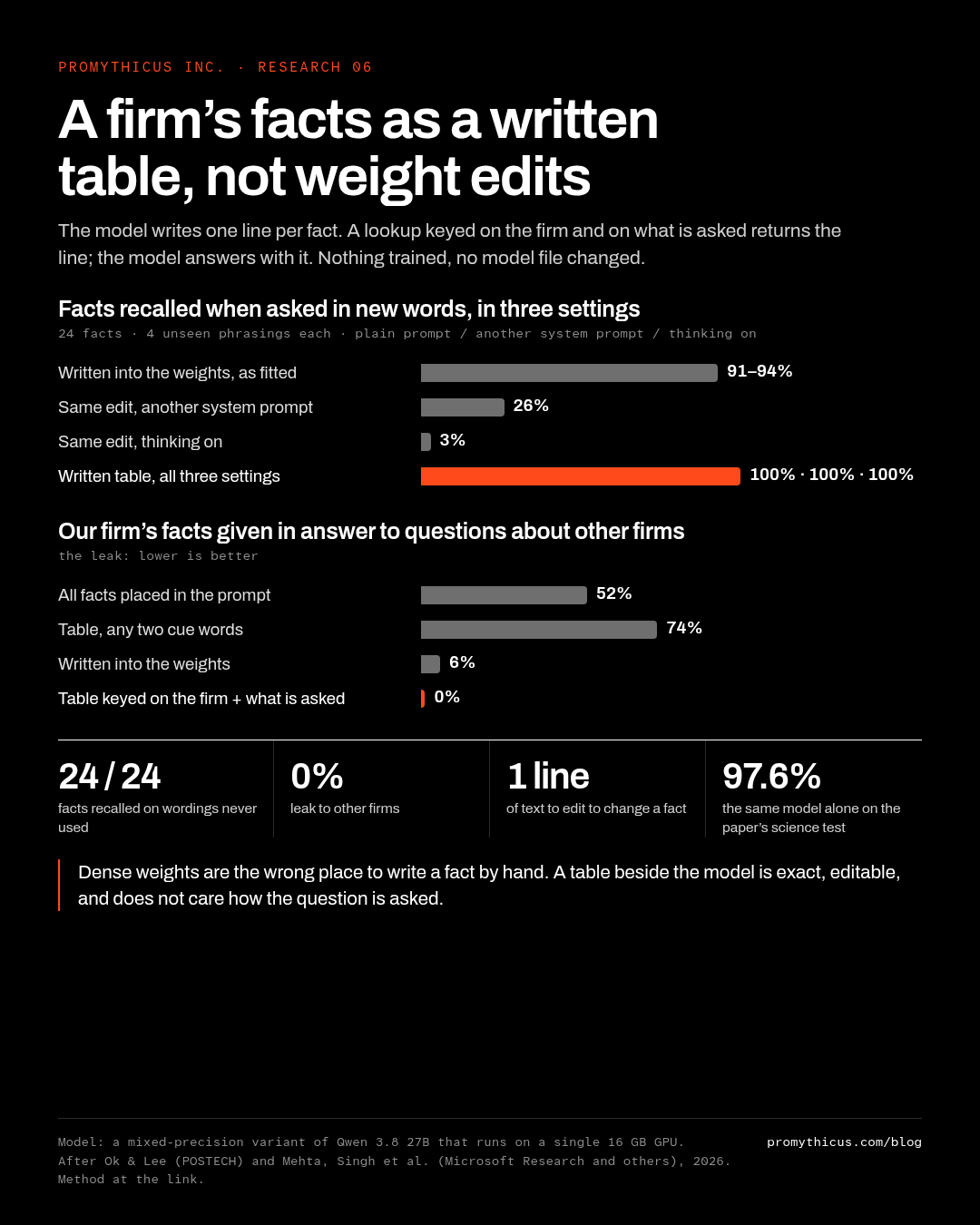
We gave a local AI model 24 facts about a fictional firm in two ways. Written into the model’s own weights, they were recalled 91 to 94% of the time, but only in the exact prompt format used: 26% under a different instruction and 3% with thinking mode on. Written by the model as plain lines in a table, and looked up by the firm plus what is asked, they were recalled 100% of the time in all three settings, and never given in answer to a question about another firm. Nothing was trained and no model file was changed. The idea of the table comes from two papers published this month, credited below.
The problem
An assistant for a firm has to know the firm: its people, its systems, its procedures. No model was trained on those. One way to add them is to edit them straight into the model’s weights with one calculation, with no training. We tested that (the full test is here): it worked in the prompt format it was fitted in and nowhere else. Change the instruction at the top of the conversation and the facts were gone. This article tests a different place to put them.
Whose idea this is
Two papers published in November 2026 changed how we looked at the problem. We did not invent what follows; we applied it.
- Hyunjong Ok and Jaeho Lee (POSTECH), Weight-Space Programming Doesn’t Need Transformers. When a large model is asked to write another model by hand, with no training, it does not write a neural network. It writes plain-text facts and compiles them into a table that a fixed procedure reads. Every answer traces to one written line. Their own design, an associative memory, addresses its rows by pairs of concepts.
- Yash Mehta, Chandan Singh and colleagues (Microsoft Research, Johns Hopkins, Columbia, NYU), Interpretable weight-space programming. Write the thing by hand, score it on examples you may look at, revise with a written reason, and score examples you never looked at once at the end.
Both build on Sparks of Weight-Space Programming by Rikiya Takehi, Jayden Teoh, Alex Zhang and Omar Khattab.
First, does their result hold?
Ok and Lee released their written models as text files. We rebuilt four of them and scored them with our own scorer on the same 3,530 school science questions (ARC):
| Their released model | Our score | Published |
|---|---|---|
| Associative memory, first generation | 49.59% | 49.59% |
| Associative memory, fifth generation | 52.37% | 52.37% |
| Table designed by the writing model | 50.80% | 50.80% |
| Hand-written two-layer Transformer | 34.22% | 34.15% |
It holds exactly. The table builds in a few seconds and answers all 3,530 questions in about one second on an ordinary processor.
The test on a firm’s facts
- Model: a mixed-precision variant of Qwen 3.8 27B that runs on a single 16 GB GPU.
- Facts: 24 invented facts about a fictional law firm (people, names of systems, numbers).
- Writing: the model itself turns each fact into one line: the words someone would use to ask, then the answer. For example: privacy officer, data protection officer, DPO > Signe Halvorsen, under the firm’s name.
- Reading: a question returns a line only when it contains both the firm’s name and words for what is asked. That is the pair-addressed memory of Ok and Lee. The model then answers with the line in front of it.
- Score: four wordings of each fact that were never used to write anything; the same questions about three other invented firms; forty general-knowledge questions.
| How the facts are held | Recalled, new wordings | Our facts given for other firms |
|---|---|---|
| In the weights, in the fitted format | 91 to 94% | 6% |
| In the weights, another instruction on top | 26% | 0% |
| In the weights, thinking mode on | 3% | 5% |
| All placed in the prompt | 100% | 52% |
| Written table, plain | 100% | 0% |
| Written table, another instruction on top | 100% | 0% |
| Written table, thinking mode on | 100% | 0% |
General-knowledge answers were unchanged (95%, the same as the untouched model).
Two mistakes on the way, and what fixed them
- The first table leaked badly: 74%. A question about another firm’s managing partner returned our firm’s line, because “managing partner” alone was enough to find it. Requiring the firm’s name to be half of the lookup key took the leak to zero. A simple keyword table cannot do that; the pair table can.
- One fact of 24 was missed. Following the second paper’s loop, we looked at the wordings we were allowed to look at, and it failed there too. The cause was ours: our reader threw away “IT” as the common word “it”, so “head of IT” looked like any other head. One line of code, with its reason written beside it, and the unseen wordings went from 95.8% to 100%.
Why this matters for a private server
- It cannot depend on how the question is asked. The fact is in a line of text, not in a pattern of weights tied to one prompt.
- It does not answer for the wrong firm. That matters for anyone holding several clients’ facts on one machine.
- Changing a fact is editing one line. No retraining, no new model file, and the line shows where an answer came from.
And on general knowledge?
The papers’ tables hold school science, so we tried mixing them with our model on their own test. Our model alone answers 97.6% of the 3,530 questions at 0.18 seconds each. The best released table answers 52.3%; with 3,331 lines our model wrote from the practice questions, 54.5%. Letting the table answer when it is sure, then a small general model, then ours, gives 90% at about twice the speed, or 97% at 1.2 times. The table adds little there: for general knowledge a trained model is simply better, as both papers say. For a firm’s own facts, which no model was trained on, the table is the right tool.
One more measurement for speed: our model’s answer is already complete at layer 52 of its 64. Stopping there would keep 97.0% and save about a sixth of the work. That is measured, not built.
Limits
- 24 facts about one invented firm, with short answers. A real firm’s facts are messier, and the lines would be written from its documents.
- One run of each test.
- A table recalls what was written. It does not reason over it; the model does that part.
Questions and answers
- How should a private AI be given a firm’s own facts?
- In our test, as plain lines in a table that the model writes and reads back, looked up by the firm’s name plus what is asked. All 24 facts were recalled in every prompt setting, and none was given in answer to a question about another firm.
- Why not write the facts into the model itself?
- We tried. The facts held only in the exact prompt format used to write them: 91 to 94% there, 26% under another instruction, 3% with thinking mode on.
- Is this just search?
- It is close to it. What the table adds is the pair key: a line is returned only when the question names both whose fact it is and what is asked. With facts simply placed in the prompt, the model gave our firm’s facts for other firms half the time; with the keyed table, never.
- Whose research is this based on?
- Ok and Lee at POSTECH, who showed that models written by hand work best as fact tables and released the associative memory we rebuilt, and Mehta, Singh and colleagues at Microsoft Research and partner universities, whose write, check and revise loop we followed. Both are linked in the sources.
Sources
- Ok and Lee (POSTECH), Weight-Space Programming Doesn’t Need Transformers (2026)
- Ok and Lee, code and released models (MIT licence)
- Mehta, Singh, Xu, Antonello, Flinker, Mesgarani, Bonner, Jojic and Gao (Microsoft Research, Johns Hopkins, Columbia, NYU), Interpretable weight-space programming builds transparent transformers and brain encoding models (2026)
- Takehi, Teoh, Zhang and Khattab, Sparks of Weight-Space Programming (2026)
- Clark et al., ARC: Think you have Solved Question Answering? (2018)
- Our code and results for this article