We repaired an AI model by editing its numbers directly. The cleverer ideas failed.
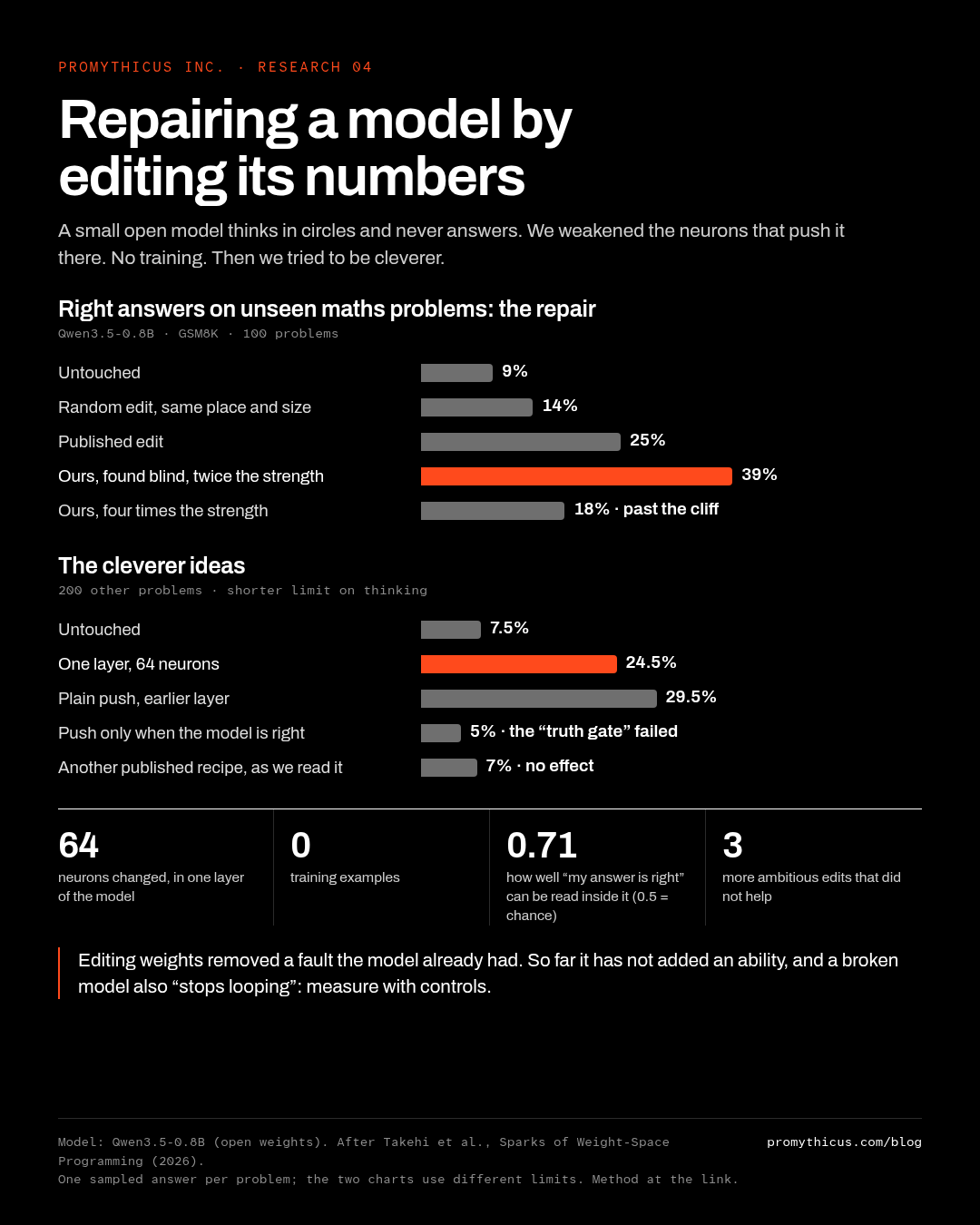
A small open language model (Qwen3.5-0.8B) often thinks in circles and never answers. We found, from its own behaviour, the direction inside it that goes with being stuck, and weakened the 64 neurons that push hardest that way. No training. On maths problems it had not seen, right answers went from 7.5% to 24.5%. Three cleverer ideas built on this (more layers, a gate that acts only when the model is right, and another published recipe) did not help. So far, editing weights removes a fault; it has not added an ability.
The question
The usual way to improve a model is fine-tuning: more training on new examples. It needs data, hours of computing, and it can damage what the model already did well. A group of researchers showed in November 2026 that a model can sometimes be improved by changing a few of its numbers by hand, after looking at how it behaves. We wanted to know how far that goes, because a firm’s server should be improvable without retraining anything.
The test
- Model: Qwen3.5-0.8B, a small open model with a known fault: on a maths problem it keeps “thinking” and often never gives an answer.
- Problems: GSM8K, school-level word problems. Practice problems to work on; separate problems, never looked at, to score.
- Rules: every edit is compared with the untouched model and with a random edit of the same size in the same place.
Reproducing the published repair, blind
The published repair changes two of the model’s 488 tables of numbers: 64 neurons in each of two layers. We did not copy it. We ran the untouched model, separated the answers where it got stuck from those where it finished, and looked for the layers that push most toward “stuck”. We landed on the same two layers and nearly the same direction.
| Model (100 unseen problems) | Right |
|---|---|
| Untouched | 9% |
| Random edit, same neurons, same strength | 14% |
| Published edit | 25% |
| Ours, same strength | 26% |
| Ours, twice the strength | 39% |
| Ours, four times the strength | 18% |
Twice the published strength was best. At four times, the model stops looping but answers wrong: there is a cliff, and a small practice set hides it.
Three cleverer ideas
These were scored on 200 other unseen problems with a shorter limit on thinking, so the numbers are lower across the board. The untouched model scores 7.5% here.
| Edit | Right |
|---|---|
| Untouched | 7.5% |
| Two layers | 19.0% |
| One layer, stronger (what a search over layers settled on) | 24.5% |
| Plain push at an earlier layer | 29.5% |
| The same push, gated by a random signal | 21.0% |
| The same push, only when the model’s answer is right (the “truth gate”) | 5.0% |
| The mirror image: push only when it is wrong | 9.5% |
| Another published recipe (AHA), as we understood it | 7.0% |
- More layers did not help. One group of neurons at the right strength beat every combination.
- The truth gate failed. We can read, inside the model, a weak sign that the answer it has in mind is right (0.71, where 0.5 is chance). We wrote two neurons by hand that push the model to commit only when that sign is on. It did worse than a gate that reads nothing. The mirror image was written only as a control and is never applied to a model we ship.
- We could not reproduce the second recipe. Its authors report a large gain; our version of it, built from their description, changed nothing at any strength. That says our reading of it fails, not that theirs does.
What we take from it
The repair is real, large, and needs no training. But it removes an obstacle the model already had; nothing here taught it something new. And the measurements have to be careful: a model that has simply been broken also “stops looping”. A recent paper on reading weights makes the same point, and we have adopted its rules: an edit that breaks the model is not a result, noise is measured rather than guessed, and every batch of edits includes some that should do nothing.
Limits
- One small model with one known fault. The larger model we run for clients does not loop on our tasks, so this repair has nothing to fix there yet.
- One sampled answer per problem. Differences of a few points are within noise; the jump from 7.5% to 24.5% is not.
- The two tables use different limits and different problems and cannot be compared with each other.
Questions and answers
- Can an AI model be improved without fine-tuning?
- Sometimes. In our test, changing 64 neurons in one layer of a small model, with no training, took it from 7.5% to 24.5% right on unseen maths problems. It worked because the model had a specific fault, getting stuck in its own thinking.
- What is a weight edit?
- A model is a large set of numbers. A weight edit changes a chosen few of them directly, after watching how the model behaves, instead of training the model on new examples.
- Does it work for anything?
- No. In our tests it removed a fault. The more ambitious edits, including one meant to make the model commit only when it is right, did nothing or made it worse.
- Is this used on client servers?
- Not yet. The model we install does not have this fault. We are testing whether the same approach can fix the faults it does have.
Sources
- Takehi, Teoh, Zhang and Khattab, Sparks of Weight-Space Programming (2026)
- Ahmed, Can an LLM Actually Reason and Program about Neural Network’s Weights? (2026)
- Khamis, Tutunov and Bou Ammar, Who Needs an LLM to Program an LLM? Introducing AHA! (2026)
- Kocabay, Weight-Space Reading (2026)
- Cobbe et al., GSM8K: Training Verifiers to Solve Math Word Problems (2021)