Can a firm’s facts be written straight into an AI model’s file? Partly.
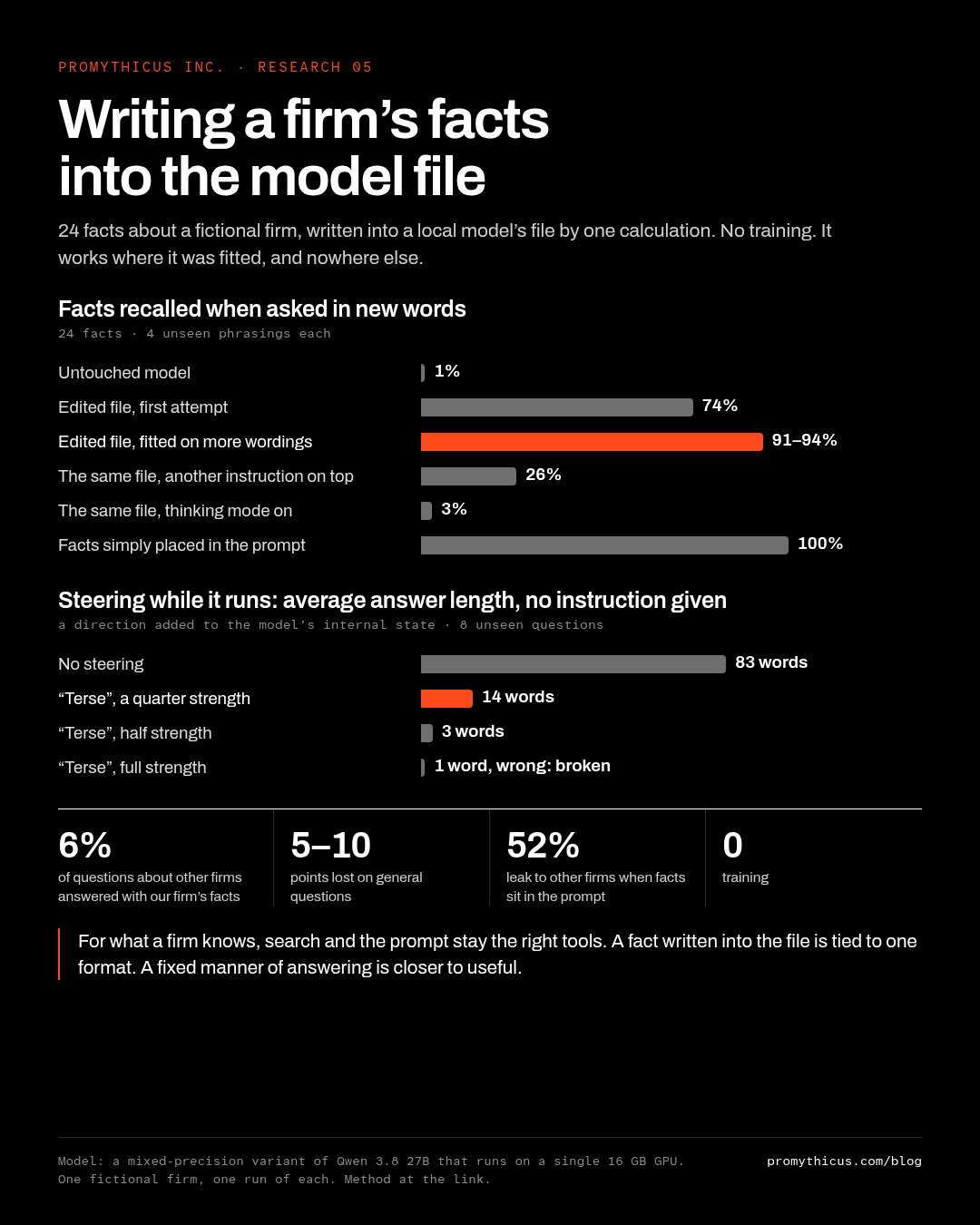
We wrote 24 facts about a fictional firm directly into the file of a local AI model, with one calculation and no training. Asked in new words, it recalled 91 to 94% of them (1% before), and gave them wrongly for other firms 6% of the time. But the edit holds only in the setting it was fitted in: with a different instruction at the top of the conversation recall fell to 26%, and with the model’s thinking mode on, to 3%. Putting the facts in the prompt still works better. Separately, a direction added to the model while it runs cut its answers from 83 words to 14 with no instruction at all.
Update, 17 November 2026: a written table does what the weight edit below could not. See A firm’s facts belong in a written table, not in the model’s weights.
The question
A firm’s assistant should know the firm: its partners, its offices, its rates, its procedures. Today that knowledge is placed in front of the model each time (in the prompt, or found by search). Could it be written into the model itself, without training, so that it is simply known?
The test
- Model: a mixed-precision variant of Qwen 3.8 27B that runs on a single 16 GB GPU. We edit a copy of the compressed file we actually run; the original is untouched.
- Facts: 24 invented facts about a fictional firm (people, names of things, numbers).
- Method: we read the model’s internal state at the point where an answer begins, with and without the facts in the prompt. One calculation (no training loop) gives a change to a single table in one layer that moves the first state to the second, with a penalty for moving the states of unrelated questions.
- Score: four phrasings of each fact that were never used; questions about other firms (it should not answer with ours); general-knowledge questions (they should not change).
Results
| Model file | Facts recalled, new phrasings | Our facts given for other firms | General questions right |
|---|---|---|---|
| Untouched | 1% | 0% | 95% |
| Untouched, facts in the prompt | 100% | 52% | |
| Edited, first attempt | 74% | 10% | 90% |
| Edited, fitted on four wordings of each prompt | 91 to 94% | 6% | 85 to 90% |
| The same file, a different instruction at the top | 26% | 0% | 85% |
| The same file, thinking mode on | 3% | 5% | 90% |
- It works where it was fitted. One layer near the end of the model was the right place; the layers just before and after it were much worse, and those further back gave under 10%.
- It does not travel. Change the instruction at the top, or let the model think first, and the facts are gone. This is recall tied to one format, not knowledge the model can reason with.
- It costs a little elsewhere. General answers dropped 5 to 10 points. One edit made the model answer “fourteen” (the firm’s number of partners) when asked how many minutes are in an hour.
- Protecting harder costs learning. A stronger penalty on unrelated questions cut the leak to other firms, and cut recall by about as much.
- A surprise about prompts: with the facts simply placed in the prompt, the model answered questions about other firms with our firm’s facts half the time. Prompts leak too.
Steering while it runs
A second technique changes no file. We ask the model 32 questions twice, once normally and once with an instruction such as “answer in as few words as possible”, and record the difference in its internal state. Adding a fraction of that difference while it answers new questions, with no instruction, changes how it answers.
| Direction added | Average answer | Example: “How do I make pancakes?” |
|---|---|---|
| None | 83 words | A full recipe with headings |
| Terse, a quarter strength | 14 words | “Mix 1 cup flour, 1 tsp baking powder, pinch salt, 3/4 cup milk, 1 egg. Whisk. Pour 1/4 cup onto hot greased pan. Cook until bubbles form, flip, done.” |
| Terse, half strength | 3 words | “Mix flour, milk, egg; fry.” |
| Terse, full strength | 1 word | One word, in Chinese, and wrong |
The window is narrow: a little gives a clean change of manner, too much breaks the output. The same method produced a pirate and a grumpy old man, both fluent at a quarter strength and both nonsense at full strength.
What we take from it
For a firm’s knowledge, search and the prompt remain the right tools: they are exact, they can be updated in a second, and they show their source. Writing facts into the file is not ready. Steering is closer to useful: a fixed manner (short, formal, in French) could be built into a server without spending prompt space on it. Neither is in what we install today.
Limits
- 24 facts, one fictional firm, short answers. Steering was judged by reading eight answers, not scored.
- One run of each. Fitting the edit across several formats at once is the obvious next step and is not done.
Questions and answers
- Can company knowledge be written directly into an AI model?
- Partly. In our test, 24 facts written into the model’s file were recalled 91 to 94% of the time on new phrasings, but only in the setting the edit was fitted in. With a different instruction or with thinking mode on, recall fell to 26% and 3%.
- Is that better than putting the facts in the prompt?
- No. Facts in the prompt were recalled 100% of the time, can be changed instantly and can show their source. Writing facts into the file is a research result, not a product feature.
- What is steering?
- Adding a fixed direction to a model’s internal state while it answers. In our test it cut answers from 83 words to 14 without any instruction. Too much of it breaks the output.
- Was the model retrained?
- No. The facts were written with one calculation on one layer, and steering changes no file at all.